1970 / 2012
The story of Queen
Queen formed in 1970; John Deacon joined in March 1971. The studio sequence followed from Queen in 1973 to Made in Heaven in 1995. Live Aid in 1985 and the 1992 Freddie Mercury Tribute Concert belong to the live history, while the later collaborations with Paul Rodgers and Adam Lambert are distinct chapters. This archive follows those connections without treating later projects as additional albums by the classic four-member line-up.
Scroll on. The story unfolds as you go.
Dates retain their original precision; a year is not converted into an invented day.
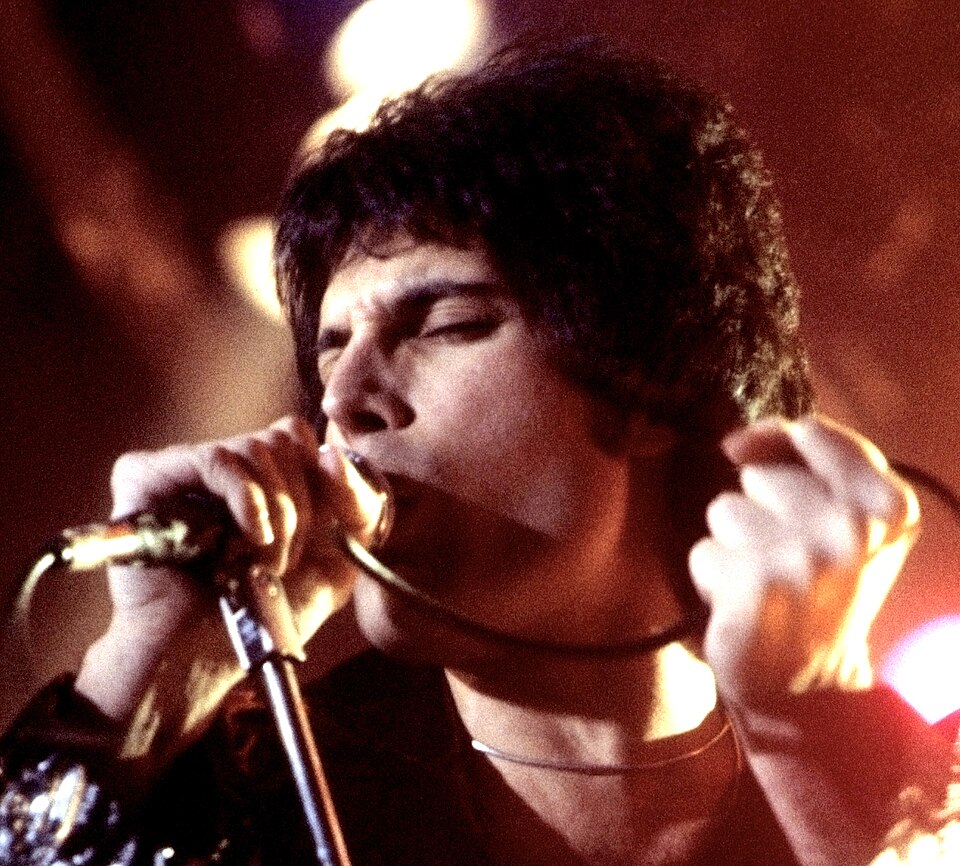
01 / 1970–1972
Four paths, one band
Queen forms in 1970. John Deacon joins in 1971: the classic quartet is complete.
Freddie Mercury · Carl Lender; derivative: Lošmi, Morn · 1977 · Source · CC BY-SA 3.0. Wikimedia preview; fitted to layout, no retouching.
Queen takes shape
The band begins in London, before there is a debut album to introduce it.
Explore · Queen takes shapeJohn Deacon joins
Freddie Mercury, Brian May and Roger Taylor are joined by bassist John Deacon. These four musicians shape the studio catalogue that follows.
Explore · John Deacon joins
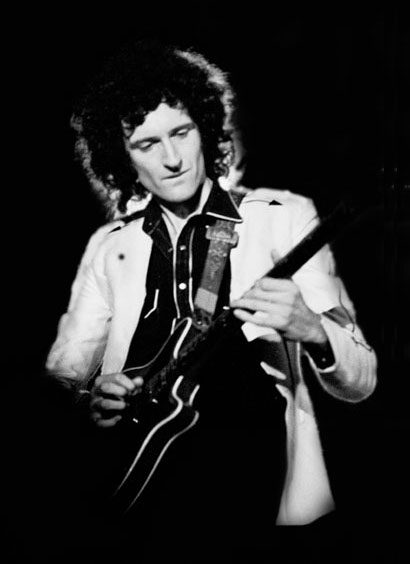
02 / 1973–1974
Finding their sound
The first records arrive. The early tours carry that music beyond Britain.
Brian May · Eddie Mallin · 1979 · Source · CC BY-SA 2.0. Wikimedia preview; fitted to layout, no retouching.
The first major UK tour
The first major British tour puts the new band in front of audiences as its debut reaches listeners.
Explore · The first major UK tourQueen
Queen's debut was recorded at Trident and De Lane Lea in London. Its different production arrangements are a reminder that a record has a working history as well as a release date. Editorially, the most useful way into this album is to follow its sequence rather than treat it as a prelude to later hits. The short closing Seven Seas of Rhye is worth comparing with the longer recording on Queen II: the work and its recordings are different levels of the archive.
Explore · QueenThe first US tour
The first American tour opens another stage for the band, in the year of Queen II and Sheer Heart Attack.
Explore · The first US tourQueen II
The original LP organised its music as Side White and Side Black. QueenOnline associates the first with Brian May's songs and Roger Taylor's contribution, and the second with Freddie Mercury's writing. That is a useful organising idea, not a licence to flatten every recording into a single style. Our editorial route pairs the opening sequence with the later sequence, keeping the short pieces in place. The track list makes those transitions visible without reproducing the sleeve photograph.
Explore · Queen IISheer Heart Attack
Recorded across studios in England and Wales, the third album was produced by Queen and Roy Thomas Baker. It also contains Misfire, identified in John Deacon's official biography as his first composition for Queen. A useful editorial approach is to keep the distinction between the album Sheer Heart Attack and the later song with that title. Read the shorter tracks alongside their neighbours: their place in the sequence gives this page a different perspective from a compilation of singles.
Explore · Sheer Heart Attack
03 / 1975–1979
A world inside a song
Bohemian Rhapsody marks 1975. The studio becomes a place for bigger musical possibilities.
Freddie Mercury · Carl Lender; derivative: Lošmi, Morn · 1977 · Source · CC BY-SA 3.0. Wikimedia preview; fitted to layout, no retouching.
Bohemian Rhapsody as a single
Bohemian Rhapsody brings the ambition of A Night at the Opera into a single. Follow its recording below to hear where this chapter leads.
Explore · Bohemian Rhapsody as a singleA Night at the Opera
The album was recorded in England across six studios in 1975. Its track list places the extended The Prophet's Song beside much shorter pieces, and ends with Bohemian Rhapsody followed by God Save the Queen. Our editorial reading centres on that change of scale: a long work is one part of the programme, not the programme itself. Compare the documented authorship of You're My Best Friend with the neighbouring songs, and keep the duration of the 2011 recording separate from the original album's publication date.
Explore · A Night at the OperaA Day at the Races
QueenOnline identifies this as the first album produced by the band themselves, with Mike Stone engineering. For an editorial route, begin with the album's own sequence rather than its resemblance in title to A Night at the Opera. Tie Your Mother Down opens that sequence and Teo Torriatte closes it. The individual song records let you move between the central tracks and those bookends, while the edition record explains which timings you are comparing.
Explore · A Day at the RacesNews of the World
We Will Rock You and We Are the Champions begin the album, while its UK publication preceded the US release. That territorial distinction matters when following the chronology. Our editorial route goes beyond the opening pair: Sheer Heart Attack here is a song, not the 1974 album. Reading the whole running order also reconnects these familiar works with the record that surrounds them, instead of treating their later public life as the only context.
Explore · News of the WorldJazz
QueenOnline records a UK release on 10 November, followed by the American release four days later. The album places Bicycle Race and Fat Bottomed Girls in a larger sequence that also includes Don't Stop Me Now. As an editorial choice, explore the spaces between those familiar titles. The archive keeps the order and identified recording timings together, so a listener can examine the album's proportions without treating a single or a later video as a substitute for the complete record.
Explore · Jazz
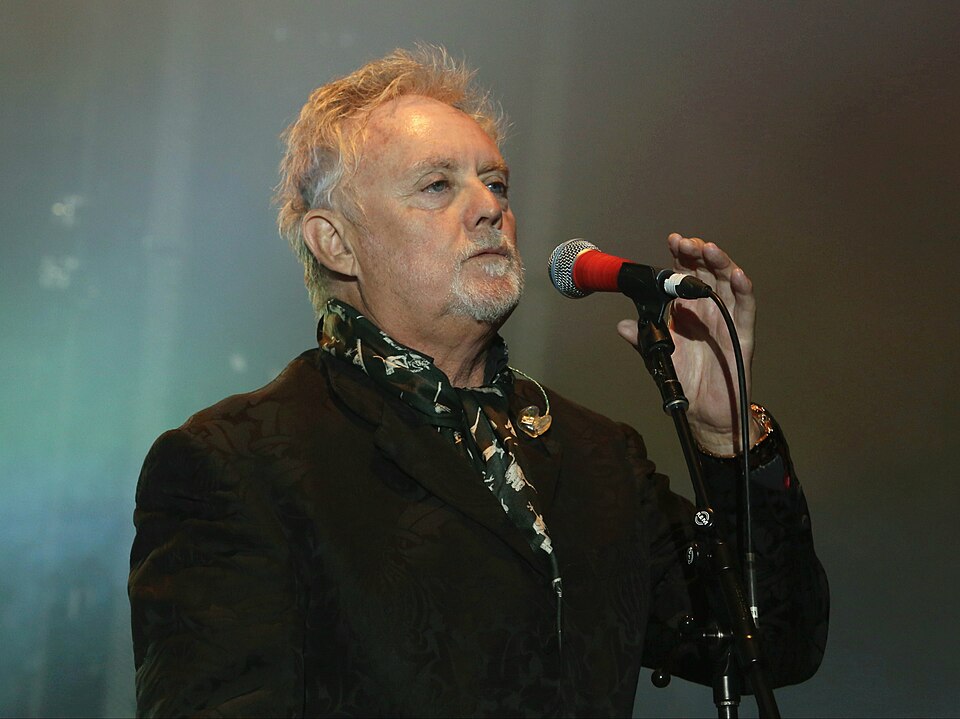
04 / 1980–1984
Changing the pulse
The Game, Flash Gordon, Hot Space and The Works lead into a new decade.
Roger Taylor · Mark Kent · 2013 · Source · CC BY-SA 2.0. Wikimedia preview; fitted to layout, no retouching.
The Game
Recorded at Musicland in Munich, The Game was produced by Queen and Mack. John Deacon's official profile documents his authorship of Another One Bites the Dust. Our editorial route contrasts that credit with the album's wider running order, from Play the Game to Save Me. This is also a useful point at which to compare original release context with later digital editions: the album belongs to 1980, while the timings displayed here describe identified remastered recordings.
Explore · The GameFlash Gordon
Flash Gordon is part of Queen's studio catalogue and a soundtrack, so its many short cues need a different reading from a conventional collection of songs. The archive retains their order rather than merging them into one generic entry. As an editorial route, use the opening Flash's Theme and closing The Hero as points of reference, then follow the intermediate titles. Recording credits remain distinct from film dialogue or characters; this site does not reproduce the film, its audio or its imagery.
Explore · Flash GordonHot Space
The album was recorded in Montreux and Munich, with Queen and Mack producing; Under Pressure has a separate production credit involving David Bowie. That exception is important: album-level credits must not erase track-level differences. Our editorial reading starts from the running order and keeps debates about artistic direction separate from factual credits. Compare the closing track with the rest of the album through its own recording and source records, rather than assuming every piece shares an identical production history.
Explore · Hot SpaceThe Works
Queen and Mack produced The Works. Official member profiles identify Radio Ga Ga with Roger Taylor and I Want to Break Free with John Deacon. Our editorial route uses those different writing voices as entrances into the complete record. The videos can illuminate an individual song, but they are external references rather than archive-owned footage. Returning from a song to the track list also reveals the shorter closing Is This the World We Created...? in its album context.
Explore · The Works
05 / 1985–1986
A stage for the world
Live Aid places Queen at Wembley in 1985. A Kind of Magic follows in 1986.
Freddie Mercury · Carl Lender; derivative: Lošmi, Morn · 1977 · Source · CC BY-SA 3.0. Wikimedia preview; fitted to layout, no retouching.
Live Aid at Wembley
Queen performs at Wembley for Live Aid. The live appearance becomes a defining moment in the band’s story.
Explore · Live Aid at WembleyA Kind of Magic
QueenOnline places the album in the band's relationship with Highlander, while the track list begins with One Vision. Our editorial route keeps the album and film contexts connected without pretending they are interchangeable editions. The member profiles give another route through the material: Roger Taylor's writing is documented for the title song and Brian May's for Who Wants to Live Forever. External media and commercial releases must be matched to the actual work or edition, rather than merely to the film's name.
Explore · A Kind of Magic
06 / 1987–1995
The last recordings, a lasting voice
Freddie dies in 1991. The tribute concert follows in 1992; Made in Heaven arrives in 1995.
John Deacon · Carl Lender · 1977 · Source · CC BY-SA 3.0. Wikimedia preview; fitted to layout, no retouching.
The Miracle
The Miracle was produced by Queen with David Richards. An archive should preserve the distinction between a public credit and a later account of an individual contribution. Our editorial route therefore makes the source of each credit visible instead of filling gaps by assumption. The running order connects Party and Khashoggi's Ship with the title song and the later singles. Later collector editions remain commercial products associated with this album, not new facts about its original release.
Explore · The MiracleInnuendo
The album's UK release came in February 1991. The official chronology places Freddie Mercury's death in November that year; those dates must remain distinct. Our editorial reading avoids turning every song into a prediction of what followed. Instead, follow the opening Innuendo through the intervening tracks to The Show Must Go On, and compare the sources behind public credits and individual writing accounts. The work itself, its recording and the later retrospective are separate layers of context.
Explore · InnuendoFreddie Mercury dies
Freddie Mercury dies on 24 November 1991. His voice remains in the recordings; the history of the four musicians reaches a painful turning point.
Explore · Freddie Mercury diesThe Freddie Mercury Tribute Concert
Brian, Roger and John return to Wembley with guest performers for the Freddie Mercury Tribute Concert.
Explore · The Freddie Mercury Tribute ConcertMade in Heaven
The official chronology describes Brian May, Roger Taylor and John Deacon completing material after Freddie Mercury's death. The album therefore calls for particular care with recording dates and editions. Our editorial route keeps the listed reprise, Yeah and Untitled visible rather than quietly discarding them because they do not resemble a conventional song. The timings belong to the identified digital edition. They should not be used to invent a duration for an abstract musical work or for every physical pressing.
Explore · Made in Heaven
07 / 1996–2012
The songs keep travelling
The musical and the collaborations with Paul Rodgers and Adam Lambert open further chapters.
Brian May · Eddie Mallin · 1979 · Source · CC BY-SA 2.0. Wikimedia preview; fitted to layout, no retouching.
We Will Rock You opens in London
We Will Rock You opens in London. The catalogue finds another life on the theatre stage.
Explore · We Will Rock You opens in LondonQueen + Paul Rodgers returns to touring
Queen + Paul Rodgers takes the music back on tour as a named collaboration.
Explore · Queen + Paul Rodgers returns to touringThe Adam Lambert collaboration
Queen + Adam Lambert begins another chapter in the live history, connected to the same songs.
Explore · The Adam Lambert collaboration
Sources and provenance
- QueenOnline · About QueenChecked: 2026-10-08
- QueenOnline · John DeaconChecked: 2026-10-08